 He holds a degree in dentistry and in Business Administration.
He is post-graduated in Marketing and Psychology. Specialist in franchises by the Franchising University.
He was honored by the International Academy of Comprehensive Dentistry for his pioneering work in Marketing Applied to Health. The best seller Marketing Applied to Health was the first book published worldwide addressing the benefits of marketing to healthcare professionals.
He writes articles for magazines and newspapers published in several countries. International speaker.
He teaches the Compact MBA course in management and marketing for healthcare professionals.
Resumo da apresentação
Management and Market: Management model and market position define the results of an office or clinic.
In relation to management and market you have four possibilities:
- Employee – You are an employee of an office or clinic;
- Professional – You have an office. You are a liberal professional;
- Employer – You have a clinic with many employees;
- Investor – You are a capital investor.
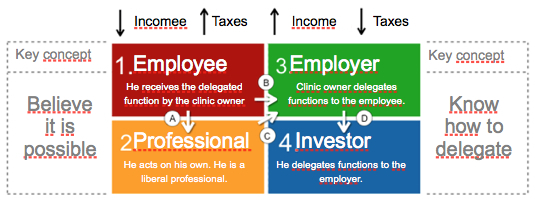
If you are an employee of the clinic, you receive function delegated by the employer, who owns the clinic. If you have an office, you are a liberal professional. If you have a clinic, you are the employer who delegates function to the employee. If you are an investor, you delegate function to the employer, making money work twenty four hours for you.
In positions 1 and 2 there is low income and they pay high taxes. So the profitability is low. In positions 3 and 4 there is high income and they pay, relatively, low taxes, having high profitability.
First you have to identify where you are: in positions 1, 2, 3, or 4. Then identify where you want to reach. The path that connects the position you are in to the position you want to reach is called strategy. If you are satisfied with the results from the position you are in, try to optimize these results. If you are not satisfied with the results from the position you are in, change your position in the market, using a strategy.
Are these the steps to define and implement a strategy?
- Step I: Diagnose where you are and where you want to reach;
- Step II: Define the strategy;
- Step III: Develop the essential competences required for the strategy;
- Step IV: Implement the strategy, that is, make it happen;
- Step V: Control the results. Without control we are adrift.
- Step VI: Make the necessary adjustments in the strategy, that is, course correction.
In positions 1 and 3 you are the business. If you don’t work, you don’t have income. If you get sick, the business gets sick. If you travel, the business travels. If you are on vacation, the business is on vacation. If you get old, the business gets old. As you are the business, it doesn’t have market value.
In positions 3 and 4 you have a business with market value because the functions are delegated. Business survives without your presence.
For those who are in the positions 1 and 2 the key concept is to believe it is possible to change to the positions 3 and 4. Having vision is essential so that you can overcome the many challenges of day-to-day. For those who are in the positions 3 and 4 the key concept is to know how to delegate functions. Delegating is not simply ordering others to do. Delegating means telling the other to do all that he does better and cheaper than you. To delegate you must have the right people on the right functions. You also need result control mechanisms. We can’t control people but we can control the results they produce.
The success of a professional is measured according to the result he has in his office, clinic or laboratory, that is, the financial result, quality of life and social prestige that he obtains through his work. To these three results together we call Prosperity.
Therefore, the positions 1, 2, 3, and 4 must always bring prosperity to those filling it. Among these positions, there are paths: Path A between the positions 1 and 2; Path B between the positions 1 and 3; Path C between the positions 2 and 3, Path D between the positions 3 and 4. As we have seen, these paths are called strategy.
A strategy links the result you have in one of the four positions to the client who is on the market. The strategy is decomposed in five variables: Product, People, Point, Price and Promotion.
To optimize the results of an office or clinic you just have to optimize the relationship between the variables Product, People, Point, Price and Promotion. You can also change your strategy by simply choosing one of the Paths A, B, C or D. To optimize results we use management knowledge.
To change the strategy we need information about the market, besides management knowledge. Management means paying attention to what is happening inside the office or clinic. Strategy means connecting the office or clinic with the market, that is, with what is outside the clinic. Acting in management and market you will multiply your results with much less effort. You will work a lot less and earn more.
Doing more with less is one of the great challenges of the twenty-first century.
Dr. Roberto Caproni (www.grupocaproni.com)