Marco Ronda
Vertical and horizontal bone regeneration in the upper and lower jaw: a 360° path for an excellent prognosis
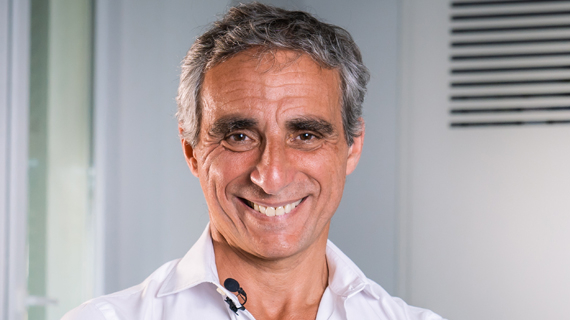
- Graduated in Medicine in 1990 at the University of Verona.
- Private clinical practice in Genoa since 1990.
- Many postgraduate courses.
- One-year-course in advanced surgery held by Prof. Massimo Simion in Milan.
- Master course in Regenerative Surgical Techniques at the University of Pennsylvania.
- Annually attends the meetings organized by the ‘American Academy of Implant Dentistry’ and several specialized courses on the techniques of horizontal and vertical bone regeneration.
- Participates annually at the Continuing Dental Education at the New York University College of Dentistry, Post Graduate.
- Periodically provides practical training courses in implantology and bone regeneration techniques at his practice.
- During the years he attended national and international congresses as a speaker.
- The International Journal of Periodontics & Restorative Dentistry published his study reporting a new surgical technique of lingual flap management appropriate in all cases of increase in bone volume; on the same magazine, a new clinical study on the management of the buccal flap titled “A novel approach for the coronal advancement of the buccal flap” has been published.
- Author of an article published on COIR magazine comparing the clinical outcomes in GBR with the e-ptfe and d-ptfe non resorbable membrane.
- Active member of the IAO (Italian Academy of Osseointegration).
- Co-founder of the Piezosurgery Academy.
Nationality: Italy
Scientific areas: Implantology
23 of november, from 14h30 until 19h00
Auditório A
Conference summary
The management of the bone defects can be performed through the application of several different surgical procedures. The major part of them needs the primary closure of the flaps, the isolation of the graft or barriers, the perfect seal of the wound. But it is note that, in order to obtain these results is necessary to advance, coronally, the buccal and lingual flaps. This procedure, if is performed with an accurate method, does not cause any problem to the flaps. We can respect their integrity and vascularization but we cannot avoid the onset of their spatial disorder.
It means that, if we would like to restore the previous anatomical spatiality, we have to conclude the bone regeneration procedure with an adequate soft tissue management.
This surgical approach is useful for the restoring of the fornix, the increasing of missing keratinized tissue band and, for the increasing of the buccal and crestal soft tissue volume, through a connective tissue grafting.
During the presentation I will focus the attention on two different type of severe bone atrophies. First is a vertical bone regeneration in the posterior Upper jaw, which involves sinus and ridge, and second, a similar severe defect in the lower jaw.
Both are treated across the conventional GBR procedure, using a titanium reinforced non absorbable membrane and grafting allograft or xenograft material mixed with autogenous bone chips.